

Blog
From data to impact: Munira and Tobi’s internship experience
07 Sep 2026
News and Insights
February 17, 2022
Last week, we launched our new Patient and Public Involvement and Engagement (PPIE) strategy. The strategy outlines how UCLPartners will be working to ensure all health and care research and innovation in our partnership is actively informed and influenced by patients and the public, using the six UK Standards for Public Involvement to guide our work:
In the creation of this document, we knew it was important to have patients and the public working with us to ensure their views and experiences shaped our current and future strategic commitments. Through a virtual strategy development session held with patient partners and several rounds of written feedback, we worked together to shape our PPIE strategy into a vision for our collaborative future.
I caught up with Raj and Cynthia to find out more about their experiences taking part in the development of the strategy, and what they’re hoping it will mean for PPIE across UCLPartners in the future.
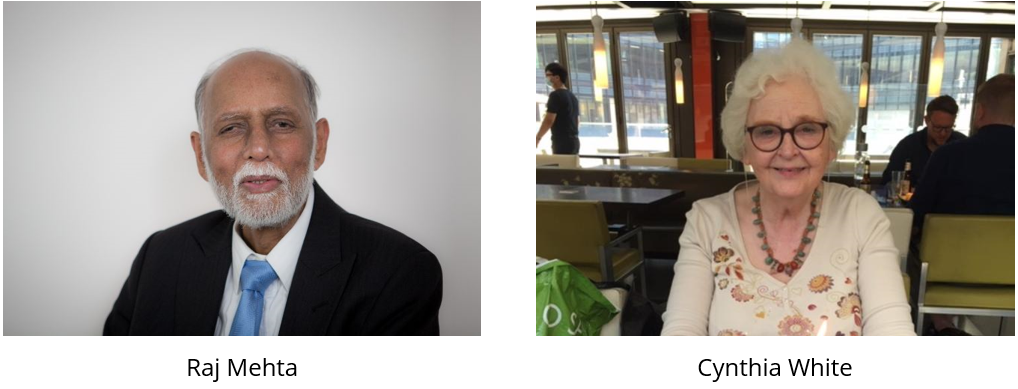
Raj is a member of the National Institute for Health Research (NIHR) North Thames Applied Research Collaborations (ARC) research advisory panel and has worked closely with UCLPartners as a patient contributor for several years. He wanted to be involved with the strategy because he’s motivated by improving the quality of healthcare. And of course, patient focused research just can’t be delivered without the involvement of patients themselves:
“I believe involving the public, service users, patients and carers early in the development of an innovation, in the evaluation of innovations and service design/improvements makes sense for a multitude of reasons – ranging from the practical to the ethical.”
Cynthia is Chair of the City and Hackney Older People’s Reference Group and has worked with UCLPartners as a patient contributor in several different ways in the past year, including sitting on interview panels for recruitment into key senior and patient-facing posts. She was motivated to get involved in the PPIE strategy development by the drive to challenge systems where deference and lack of reaching-out gets in the way of involvement and co-production between the medical profession and patients:
“I think the most important thing is managing to make contact and get feedback from and involvement with those people who we are not hearing from.”
Taking part in the strategy development session, and providing further input via email, was valuable to UCLPartners and to them both – Raj is pleased that he was able to emphasise the importance of clear objectives and commitment to implement within the strategy.
“We needed something measurable here so that we know what we’ve achieved.”
And Cynthia is excited to see that UCLPartners’ work in accessibility and with people who are marginalised – the ‘pull’ factor that drew her to engage with its development programme – now features so strongly in its strategy.
“I am very much interested in that approach and in seeing it applied to the whole area of strategic planning – ‘from little acorns mighty oaks do grow!’”
But what will the strategy do? Raj and Cynthia hope that it will demonstrate commitment and buy-in across all levels of UCLPartners. They want its passion and commitment translated into more joined-up thinking, yielding more of the strategic work that brings in our partners and their priorities as well as our own.
“There’s a huge amount of passion and commitment and enthusiasm from the team – we want to see things move faster.”
Finally, I asked about what made the PPIE work of UCLPartners special. For Cynthia, it is the deep-rooted commitment to the principles of patient involvement and learning from it. “I’ve been very much impressed by the way in which all UCLP colleagues have related to us, respected us, listened to us – and then followed it up by showing us they’ve actually done something with what we said: We said -They did!”
We hope that, with this strategy launch, we can live up to these expectations, and ensure that over the next three years our planned activities are robustly informed by a diverse range of patient, carer and public insights.
If you would like to be involved in Patient and Public Involvement and Engagement at UCLPartners, please email PPIE@uclpartners.com and mention that you would like to join our patient network, to receive newsletters and information on PPIE projects you can take part in.